



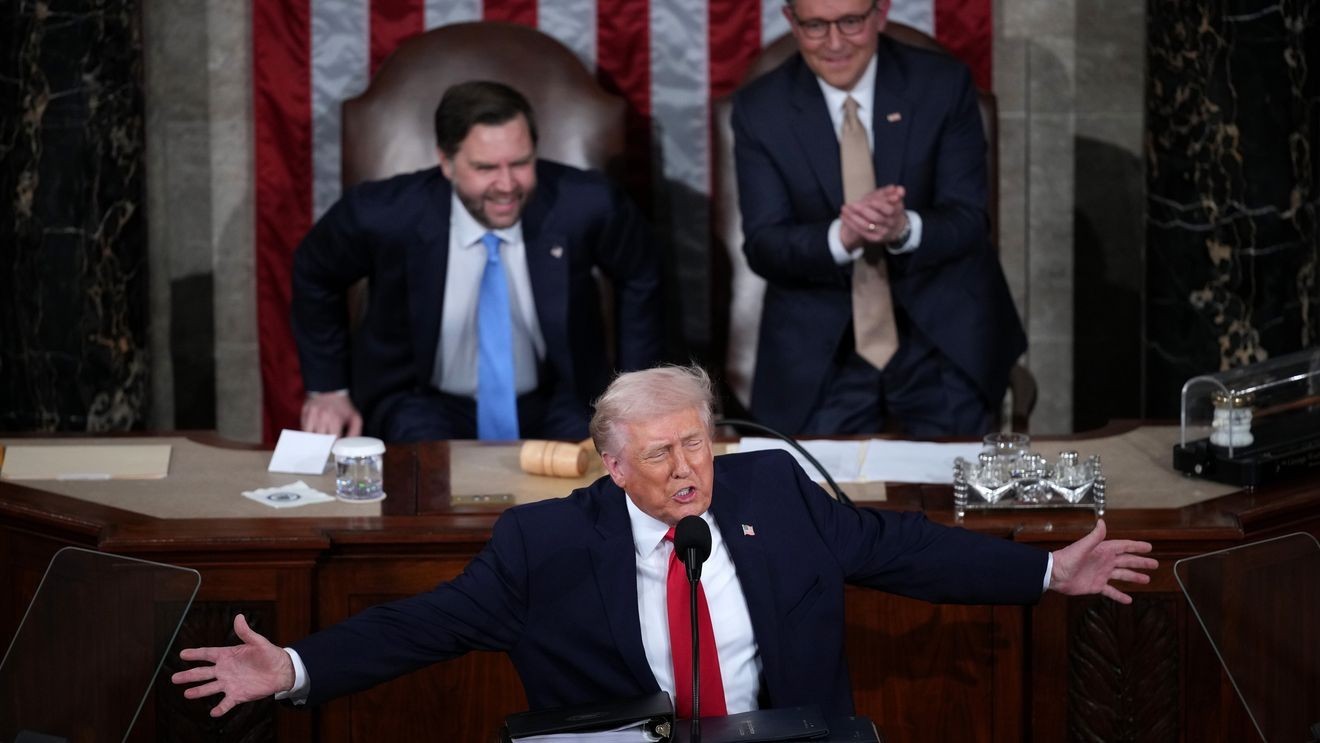
President Donald Trump delivered his State of the Union address, using the high-profile platform to promote his administration’s economic policies and rally support for Republican candidates ahead of the November midterm elections. Trump declared that America’s “golden age” is being unlocked through his leadership, touting tariffs, tax cuts, and various cost-reduction initiatives as evidence of national renewal. The address comes at a critical juncture as Republicans face challenging polling numbers and historical headwinds in their effort to maintain control of the House of Representatives.
Speaking to a divided Congress, Trump championed what he described as a year of successes while promising additional achievements to come. He introduced the men’s Olympic hockey team during the speech and claimed Americans are “winning so much” under his administration, contrasting current conditions with what he characterized as widespread problems when he took office.
Trump State of the Union Focuses on Economic Messaging
The Trump State of the Union address centered heavily on economic themes, particularly affordability concerns that polling indicates are paramount to voters. Trump called on Congress to pass several proposals aimed at lowering costs, including a ban on institutional investors purchasing single-family homes and his “Most Favored Nation” drug pricing policy. Additionally, he proposed redirecting health insurance payments into health savings accounts, according to the administration’s outline.
The president also unveiled a new retirement savings initiative that would extend federal worker-style retirement accounts to Americans without employer-sponsored plans. Under the proposal, the administration would match contributions up to $1,000, though details about implementation and congressional funding remain unclear.
Economic Challenges Overshadow Republican Midterm Prospects
However, Trump faces significant headwinds on the economic messaging front. Inflation has pushed prices up 25% since the pandemic’s end, according to economic data, creating voter frustration that has eroded Republican approval ratings. Polling shows Americans are increasingly skeptical of GOP handling of affordability issues, presenting challenges for Republican lawmakers hoping tax cuts and other initiatives will improve their electoral prospects.
The president’s tariff policies have generated particular controversy. Meanwhile, the Supreme Court recently struck down a key component of his tariff regime, forcing the administration to scramble for alternatives. Trump referenced the decision as “unfortunate” during his address, with several justices who ruled against him seated nearby.
Trump defended his tariff approach by claiming he “called the economy correctly” while “22 Nobel Prize winners in economics” were wrong. Nevertheless, the levies have caused divisions within the GOP, with some Republicans voting to roll back certain tariffs amid concerns about rising consumer prices.
Technology and Energy Concerns Addressed
Addressing growing concerns about artificial intelligence infrastructure, Trump announced that Big Tech companies had signed a “rate payer protection pledge” regarding data center energy demands. He did not provide specific details but emphasized that technology companies need to supply their own power rather than burdening consumers. Utility bills climbed 6.7% nationally last year, according to industry data, prompting some states to question data center development.
In contrast to the domestic policy focus, Trump also addressed foreign policy matters, particularly regarding Iran. The president stated his preference for diplomatic solutions while warning he would never allow Iran to acquire nuclear weapons. U.S. negotiators are scheduled to meet Iranian counterparts in Geneva on Thursday, though breakthrough progress has been elusive despite significant military buildup in the Middle East.
Congressional Divisions on Full Display
The address highlighted deep partisan divisions, with heated exchanges between Trump and Democratic lawmakers. Rep. Al Green was escorted from the chamber after displaying a sign, while many Democrats boycotted the speech altogether in protest of administration policies. Virginia Governor Abigail Spanberger, who recently flipped her state’s governorship, delivered the Democratic rebuttal.
Republicans now face the challenge of translating Trump’s State of the Union messaging into electoral success in November’s midterms. With narrow House margins and historical trends favoring the opposition party, the coming months will test whether the administration’s economic arguments resonate with voters concerned about affordability and inflation.