



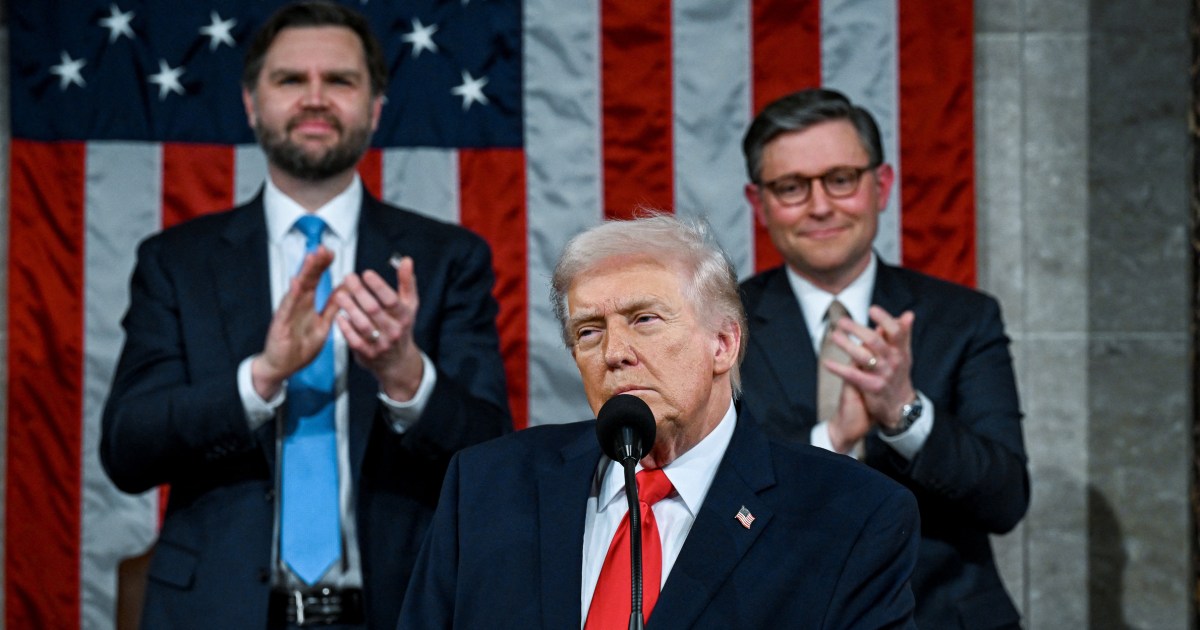
As President Donald Trump prepares to deliver his 2026 joint address to Congress, a review of Trump campaign promises from last year’s speech reveals a mixed record of fulfillment. The assessment examines commitments spanning national security, economic policy, federal workforce reforms, and international relations. While some promises have been achieved through legislation or executive action, others remain unfulfilled or have evolved significantly from their original intent.
The review, conducted ahead of this year’s address, evaluates the status of major pledges Trump made during his previous congressional appearance. These include proposals to reclaim the Panama Canal, balance the federal budget, implement sweeping tariffs, and pursue territorial ambitions in Greenland. Additionally, the analysis examines economic commitments related to inflation, mortgage rates, and tax policy.
Panama Canal and Federal Workforce Trump Campaign Promises Fall Short
Trump’s declaration that his administration would reclaim the Panama Canal and had “already started doing it” has not materialized into concrete action. According to reports, while Secretary of State Marco Rubio visited Panama to address concerns about Chinese influence in the canal, the administration has made no formal moves toward reclamation. Trump has largely ceased mentioning this promise in recent months.
Similarly, the president’s commitment to drastically reduce the federal workforce through the Department of Government Efficiency (DOGE) has proven problematic. The initiative, established on Trump’s first day in office, laid off thousands of federal employees and slashed funding for organizations like USAID. However, DOGE ended in November, well before its anticipated July 4, 2026 conclusion date. The administration subsequently rehired hundreds of federal employees that agencies needed to carry out basic functions, according to reports.
Economic Promises Show Mixed Results
Trump’s pledge to defeat inflation by eliminating fraud, waste, and theft has shown partial progress. Annual inflation stood at 2.4% in January, down from 3% when Trump took office, though not completely “defeated” as promised. Meanwhile, thirty-year mortgage rates fell below 6% last month for the first time in three years, representing a decline of more than 1% during Trump’s second term.
However, the promise to lower car payments has not been realized, as car payments have continued to rise. Trump’s “One Big Beautiful Bill” attempted to address this by including a provision allowing Americans to deduct interest payments on new car loans. Additionally, the president’s commitment to balance the federal budget within the near future remains unfulfilled, despite Trump posting on social media about the possibility of using tariff revenue to achieve this goal.
Tariff Policy Faces Legal Setbacks
Trump successfully implemented reciprocal tariffs on dozens of countries as promised, raking in $130 billion in tariff revenue. However, the Supreme Court struck down his use of the International Emergency Economic Powers Act to implement certain tariffs, including the 25% tariff on some goods from Canada, China, and Mexico intended to curb fentanyl flow. In response, Trump imposed a 10% global tariff using Section 122 authority and vowed to reinstate additional tariffs through other legal mechanisms.
The administration’s pressure on Mexico regarding cartel leadership has yielded results. On Sunday, the Mexican government killed the cartel leader of the Jalisco New Generation Cartel, “El Mencho,” in a move widely interpreted as an attempt to demonstrate serious commitment to cracking down on drug trafficking organizations. This action followed Trump’s claim last year that Mexico had handed over 29 cartel leaders due to tariff pressure.
Tax Legislation Achieves Key Campaign Commitments
Trump’s tax promises have largely been fulfilled through the “One Big Beautiful Bill” passed by Congress. The legislation included no tax on tips, no tax on overtime, and no tax on Social Security benefits for seniors, as pledged. Additionally, the bill extended Trump’s 2017 Tax Cuts and Jobs Act, offering lower individual income tax rates, and included a “working families” tax cut along with a $6,000 bonus deduction for certain Americans ages 65 and over.
Defense and Infrastructure Projects Progress Slowly
The promised Golden Dome missile defense shield remains under development but not yet operational. In May, Trump appointed Space Force Gen. Michael Guetlein to oversee the project with a goal of completion by the end of his term, according to reports. Defense Secretary Pete Hegseth recently stated the administration is “running as fast as we can on Golden Dome” to defend the American homeland.
Trump’s commitment to resurrect American shipbuilding through a new White House office has been partially implemented, with the Office of Shipbuilding folded into the Office of Management and Budget, according to USNI News. Meanwhile, the Alaska natural gas pipeline project remains hypothetical despite Trump’s claim last year that it was “all set to go.” Interior Secretary Doug Burgum recently removed land orders to open millions of acres of public land supporting the project, but significant development remains distant.
The Greenland acquisition promise has shifted significantly from Trump’s original declaration that “one way or the other, we’re going to get it.” Following initial aggressive rhetoric and a meeting with the NATO secretary-general, the administration has moved toward a more modest deal that would allow increased U.S. military presence on the Danish territory rather than outright acquisition. As Trump prepares for this year’s address, observers will be watching whether he doubles down on unfulfilled promises or pivots to new priorities for the remainder of his term.