



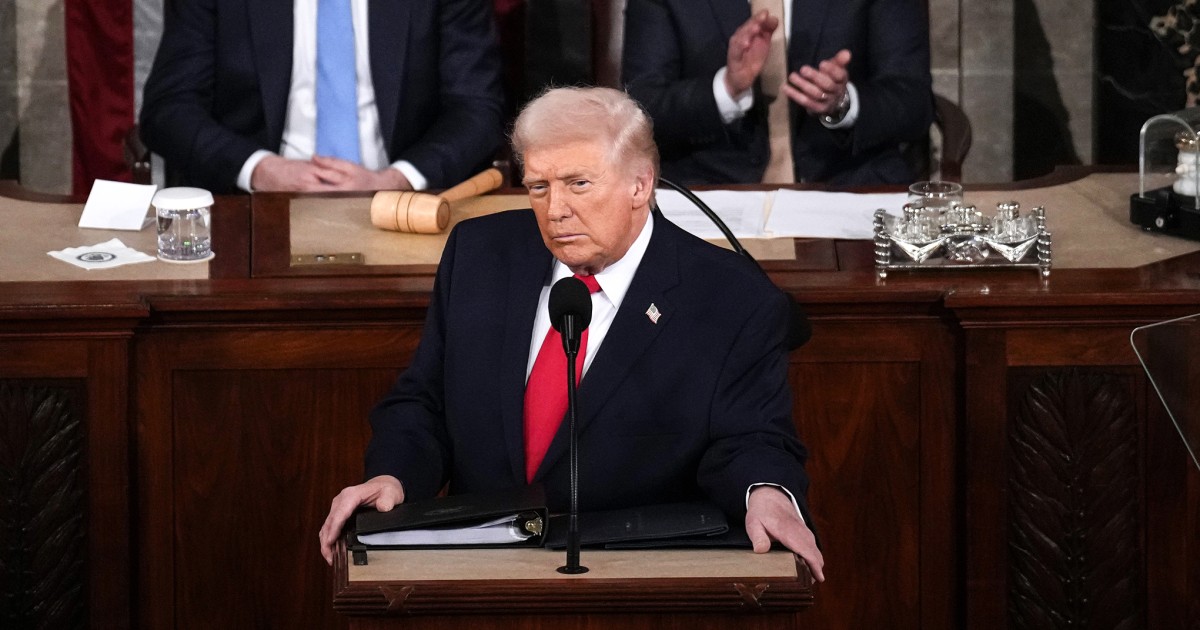
President Donald Trump delivered a State of the Union address Tuesday night that stretched nearly two hours and painted an optimistic picture of American prosperity, declaring a “turnaround for the ages” despite polling data showing most voters remain dissatisfied with the nation’s direction. Speaking to a joint session of Congress in the House chamber, Trump characterized the United States as experiencing a “golden age” with a “roaring economy” that is stronger than ever before.
The president wore a navy suit with a red tie and flag pin as he presented statistics and policy achievements during his record-breaking 1-hour, 47-minute speech. He described America as “back bigger, better, richer and stronger than ever before,” emphasizing economic gains and policy victories. Four Supreme Court justices attended the address, including three who had voted against his tariff policies just days earlier.
Trump Defends Tariffs Following Supreme Court Ruling
Despite a recent adverse Supreme Court decision striking down his unilateral tariffs, Trump vowed to maintain the levies on foreign goods. According to the president, “these powerful, country-saving, peace-protecting tariffs will remain in place under fully approved and tested alternative legal statutes.” He claimed the tariffs would eventually replace the income tax entirely, though most economists indicate these costs are primarily borne by American consumers.
The president also highlighted popular provisions from his 2025 tax cut legislation. Trump touted policies ranging from eliminating taxes on tips for wage workers to creating investment accounts for newborns called “Trump accounts,” which he said could grow to $100,000 or more by the time children turn 18 with modest additional contributions.
Voter Perception Contradicts Presidential Claims
However, public opinion surveys consistently show that Americans remain unsatisfied with economic conditions 13 months into Trump’s second term. According to polling data, most voters do not approve of his handling of immigration enforcement or his overall job performance in the Oval Office. The disconnect between the State of the Union address rhetoric and public sentiment raises questions about whether the speech will influence voters ahead of upcoming elections.
Additionally, the president’s characterization of economic prosperity conflicts with voter concerns about affordability. Progressive Democratic candidate Saikat Chakrabarti, running for a House seat in San Francisco, said before the speech that Trump has accelerated existing economic challenges. He stated that the president “campaigned on bold, sweeping economic changes, getting the prices down, ending our forever wars, and all we’ve seen since he’s come into office is him super-charging that decline.”
Heated Confrontation Over Immigration Policy
The address featured perhaps the most intense exchange between a president and members of Congress during a joint session in modern history. When Trump discussed border security and mass deportation efforts, he told Democrats they should “be ashamed of yourselves” for not standing when he emphasized protecting American citizens over undocumented immigrants.
Representatives Ilhan Omar and Rashida Tlaib responded by shouting “You have killed Americans!” The lawmakers referenced federal agents killing American citizens Renee Nicole Goodman and Alex Pretti during an immigration enforcement operation in Minneapolis last month. Omar shouted “You should be ashamed!” directly at the president during the heated confrontation.
Bipartisan Moments and Legislative Proposals
Meanwhile, the speech did include some bipartisan moments, including recognition of the gold medal-winning U.S. Olympic men’s hockey team. Both sides of the aisle gave a standing ovation to the athletes, with chants of “U-S-A!” echoing through the chamber. Trump also received bipartisan support when calling on Congress to pass legislation banning stock trades by lawmakers.
In contrast to these unifying moments, many of Trump’s legislative proposals face uncertain prospects given narrow partisan margins and upcoming midterm elections. The president proposed contributing $1,000 annually to workers’ retirement accounts and called for passage of the “Dalilah law” to ban states from issuing commercial driver’s licenses to undocumented immigrants. These initiatives would require congressional action at a time when lawmakers remain deadlocked over funding for the Department of Homeland Security.
Foreign Policy and Iran Nuclear Threat
Trump addressed America’s global position near the end of his remarks, focusing particularly on tensions with Iran. While praising a June military mission he claimed had knocked out Iran’s nuclear capabilities, the president acknowledged the regime in Tehran is “pursuing their sinister nuclear ambitions.” He stated his preference to solve the problem through diplomacy but warned he would “never allow the world’s No. 1 sponsor of terror to have a nuclear weapon.”
Republican leaders expressed confidence in Trump’s agenda following the address. Representative Richard Hudson, chair of the National Republican Congressional Committee, said in a statement that “House Republicans are proud to stand with President Trump to keep our majority and continue advancing an agenda focused on safety, opportunity, and common sense.”
Democratic lawmakers offered sharp criticism of the speech and what they characterized as omissions. Senator Chris Coons noted “the ratio of minutes to substance was stunningly low,” while Representative Joaquin Castro accused Trump of “lying to Americans that everything is perfect while people struggle to pay for groceries, rent and child care.” Several Democrats also criticized the administration’s incomplete release of files related to Jeffrey Epstein, despite a law Trump signed requiring full disclosure.
The political impact of Trump’s State of the Union address remains unclear as both parties prepare for midterm elections. Lawmakers will continue negotiating over pending legislation and appropriations bills, though the prospects for major bipartisan achievements appear limited in the current political environment.