



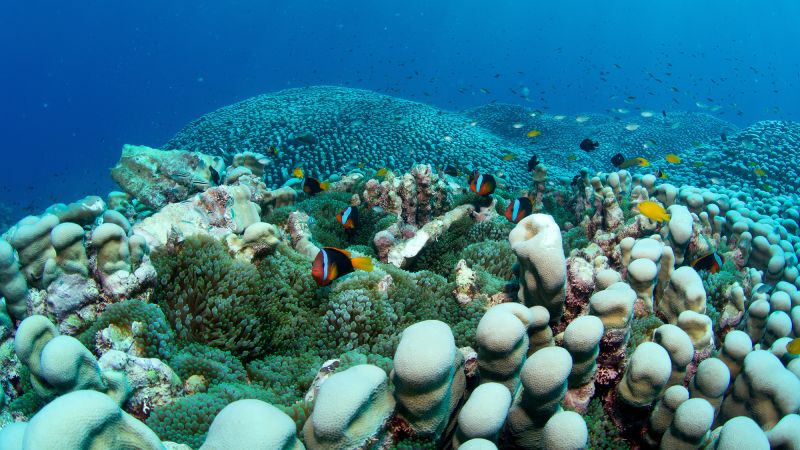
A mother-and-daughter team of citizen scientists has discovered the world’s largest known coral colony on the Great Barrier Reef off Australia’s coast. The massive coral structure spans approximately 111 meters in length and covers nearly 3,973 square meters, making it one of the most significant coral discoveries ever documented on the reef, according to Citizens of the Reef.
Sophie Kalkowski-Pope, marine operations coordinator at Citizens of the Reef, and her mother Jan Pope, an experienced underwater photographer and diver, made the discovery late last year. The organization announced the finding in a statement released Tuesday, confirming that the colony represents the largest documented and mapped coral colony in the world.
Discovery of the Largest Known Coral Colony
Pope had initially dived at the site a week before the official measurement expedition and recognized she had encountered something extraordinary. The pair subsequently returned equipped with specialized measuring equipment to document the find properly.
According to Kalkowski-Pope, the significance of the discovery became immediately apparent upon entering the water. She filmed a three-minute video swimming across the J-shaped coral structure, illustrating its remarkable scale.
Scientific Verification and Documentation
Scientists verified the Pavona clavus coral colony’s dimensions through manual underwater measurements combined with high-resolution imagery captured from water surface platforms. This comprehensive data was then used to create a detailed 3D model of the coral structure, according to Citizens of the Reef.
The spatial modeling serves an important purpose beyond documentation. Serena Mou, research engineer at Queensland University of Technology’s Centre for Robotics, explained that the model enables researchers to conduct direct comparisons over time and monitor how the coral changes in future months and years.
Environmental Conditions and Protection Measures
Researchers have identified unique environmental characteristics at the site that may explain the existence of such a large coral colony. The location experiences strong tidal currents and relatively low exposure to tropical cyclone waves compared with many other areas of the Great Barrier Reef, and scientists are investigating whether these conditions contributed to the coral’s exceptional growth.
However, the exact location of the coral colony remains undisclosed. Citizens of the Reef stated this decision aims to reduce the risk of unintended impacts on the delicate structure.
Context of Global Coral Bleaching Crisis
The discovery comes amid significant challenges facing coral reefs worldwide. Australia’s Great Barrier Reef, the planet’s largest living structure and home to diverse marine species, has endured multiple devastating mass bleaching events in recent years, transforming vibrant coral sections into bright white.
Additionally, an ongoing global bleaching event that began in 2023 has affected more than 80 percent of the world’s coral reefs due to record-high marine temperatures. Coral bleaching depletes the algae that live inside corals and serve as their primary food source, often proving fatal to the organisms.
Role of Citizen Science in Reef Conservation
The mother-and-daughter team discovered the largest known coral colony while surveying the reef from their family boat as participants in the Great Reef Census. This collaborative conservation effort involves more than 100 vessels collecting reef imagery across the Great Barrier Reef.
Pete Mumby from the Marine Spatial Ecology Lab at the University of Queensland noted that the Great Reef Census helps identify critical sources of reef recovery. This enables scientists and reef managers to better target their protection efforts.
Andy Ridley, CEO of Citizens of the Reef, emphasized that the initiative represents part of broader efforts to engage public participation in conservation work. The Great Reef Census was developed to complement existing monitoring programs by gathering large-scale data through thousands of citizen scientists already on the water.
Scientists plan to continue monitoring the site using the 3D model as a baseline for future assessments. The ongoing research will help determine whether the unique environmental conditions at the location can provide insights for coral conservation strategies elsewhere on the reef.