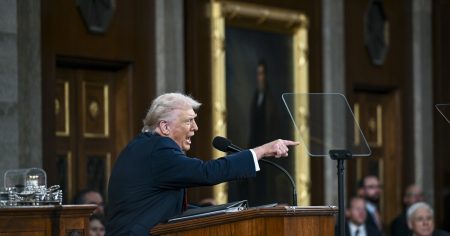




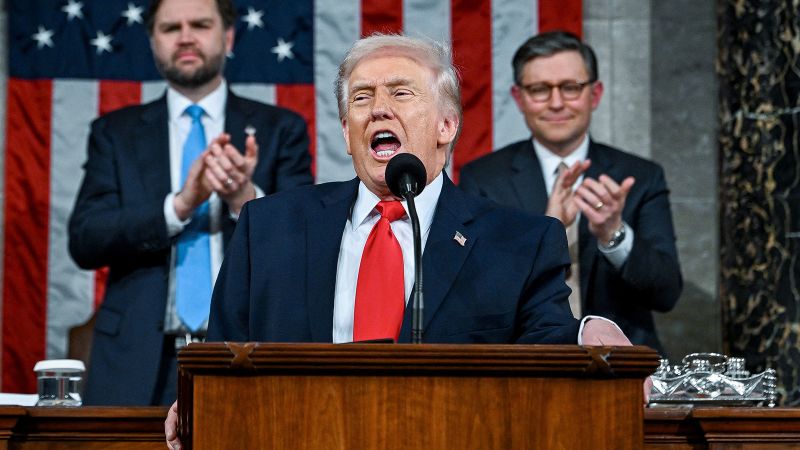
President Donald Trump made exaggerated claims about NATO defense spending during his State of the Union address, overstating the historical US financial burden within the alliance. Trump asserted that the United States was “paying for almost all of NATO” before he pushed member nations to increase their defense budgets, but official NATO defense spending figures contradict this characterization. While the US has long been the largest contributor to NATO defense spending, it has never shouldered nearly the entire cost.
According to NATO figures, US defense spending accounted for approximately 72% of total NATO defense spending in 2016, the year before Trump’s first term began. By 2024, before he returned to office, that share had decreased to about 63%. Although these percentages represent substantial US contributions, they fall short of the “almost all” description Trump used in his address.
NATO Defense Spending Contributions Break Down
The distinction between overall defense spending and NATO’s organizational budget reveals a more nuanced picture. Under an agreed formula, the United States provided approximately 16% of NATO’s organizational budget when Trump returned to office in 2025. In contrast, when he first took office in 2017, the US was contributing about 22% of that budget, according to NATO data.
Trump also highlighted NATO members’ 2025 commitment to spend 5% of gross domestic product on defense-related and security-related spending by 2035. This target includes at least 3.5% of GDP on core defense requirements previously covered by the 2% GDP benchmark. However, the president’s suggestion that members are “now paying 5 percent as opposed to not paying 2 percent” misrepresents the current situation.
Most NATO Members Fall Short of New Targets
The reality is that most NATO members have not yet achieved the new higher spending targets. NATO estimates indicate that only three member nations—Poland, Lithuania, and Latvia—reached or exceeded 3.5% in core defense spending in 2025. Additional countries may join this group in 2026, but the broader alliance has a decade to meet the full 5% commitment.
Professor Erwan Lagadec of George Washington University challenged Trump’s characterization in January, stating it is “absolutely not true that the Allies are currently ‘paying 5%’ on hard defense.” Additionally, he noted that by 2035, NATO members have only committed to 3.5% in terms of conventionally understood defense budgets. As of mid-2025, no NATO ally is spending 5% or even 4.5% of GDP on defense, according to Lagadec.
Historical Context of NATO Defense Spending Debates
The debate over NATO defense spending has been a recurring theme throughout Trump’s political career. During his first presidency, Trump frequently pressured European allies to increase their military expenditures, arguing that the burden-sharing arrangement was unfair to American taxpayers. Meanwhile, NATO defense spending has gradually increased across member states since 2014, when allies agreed to move toward the 2% GDP target following Russia’s annexation of Crimea.
The increased spending targets reflect growing security concerns in Europe, particularly following Russia’s full-scale invasion of Ukraine in 2022. In contrast to previous years when many NATO members struggled to meet the 2% threshold, more countries are now prioritizing defense investment. However, the gap between political commitments and actual spending levels remains significant for most alliance members.
NATO members will continue working toward the 2035 deadline for the 5% GDP target, though intermediate benchmarks and progress reports are expected in the coming years. The alliance has not announced specific enforcement mechanisms or consequences for members who fail to meet the agreed spending levels.